
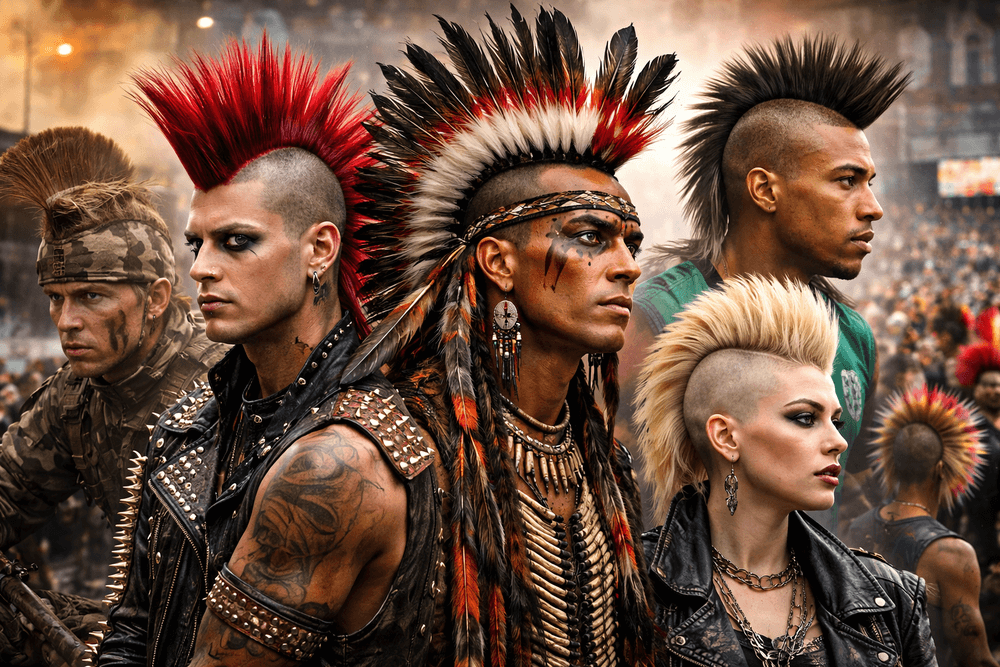
The Mohawk carries more meaning than any haircut has a right to. Over thousands of years, it transformed from a warrior’s battle crown to a symbol of rebellion, then into mainstream fashion. Each culture and era added layers of significance, turning a simple hairstyle into a complex cultural statement.
The Warrior’s Mark
The oldest and most universal meaning of the Mohawk is warfare. Across continents and centuries, this hairstyle said one thing: I’m ready to fight.
The traditional Mohawk hairstyle symbolized strength, bravery, and tribal identity. Native American warriors decorated their hair with feathers and beads, expressing individuality while honoring their heritage. For the Kanien’kehá:ka people, young men who wore the scalp lock were the designated protectors of the tribe.
The Pawnee warriors of the Great Plains wore the roach style before battle. Ukrainian Cossacks shaved their heads leaving the oseledets – a long central strip that marked them as military men. The oseledets hairstyle dates back to the Middle Ages and has been coopted as a symbol of resistance against the Russians.
During World War II, American paratroopers revived this warrior tradition. Before jumping into Nazi-occupied France, soldiers from the 101st Airborne shaved mohawks to intimidate the enemy. The message remained consistent across cultures: this person is dangerous.

Rebellion and Anti-Establishment
The 1970s punk movement gave the Mohawk its most radical transformation. What had been a warrior’s mark became a middle finger to society.
London punks gathered in places like Sloane Square, and as the movement gained traction, outsiders would come to gawk at the variety of hairstyles on display. The punk Mohawk wasn’t just about shock value. It represented a complete rejection of mainstream values – capitalism, conformity, politeness, everything.
Bands like The Exploited and The Sex Pistols made the Mohawk synonymous with anti-authoritarianism. It was a visceral, visual rejection of mainstream societal norms, a middle finger to the polished, feathered hairstyles of the era. Punks spiked their mohawks with glue, dyed them neon colors, and made them as tall and aggressive as possible.
The style meant you couldn’t hide. You couldn’t slip into normal society with a foot-tall green mohawk. That was the point – total commitment to being outside the system.
Indigenous Pride and Resistance
In the 1960s and again in the 1990s, the Mohawk took on new political meaning for Indigenous activists. The hairstyle was adopted by some Indigenous activists as a symbol of resistance against colonialism and cultural oppression.
In the 1990s, Mohawk Warriors, a group of Indigenous activists involved in land disputes in Canada and the United States, reclaimed the term ‘mohawk’ as a symbol of resistance and pride. They used it to unite Indigenous communities and raise awareness about sovereignty and rights.
For many Indigenous people today, wearing a traditional scalp lock or mohawk connects them to their heritage. It’s a visible assertion of identity in a world that tried to erase their culture.
Individual Expression
Beyond group identity, the Mohawk became a tool for personal expression. Each variation tells something about the wearer.
The Liberty Spikes – individual spikes of hair standing straight up – show maximum commitment to standing out. The Death Hawk – a wider strip of hair – suggests someone who wants the rebellious look but with more styling options. The Fauxhawk – styled to look like a mohawk without shaving the sides – says “I’m edgy but I still need my corporate job.”
The versatility of the Mohawk allows for a range of styles, from spiked and dramatic to subtle and refined, appealing to a wide audience. Modern variations include the burst fade mohawk, the curly mohawk, and the braided mohawk – each allowing personal creativity within the classic form.
Gender and Power
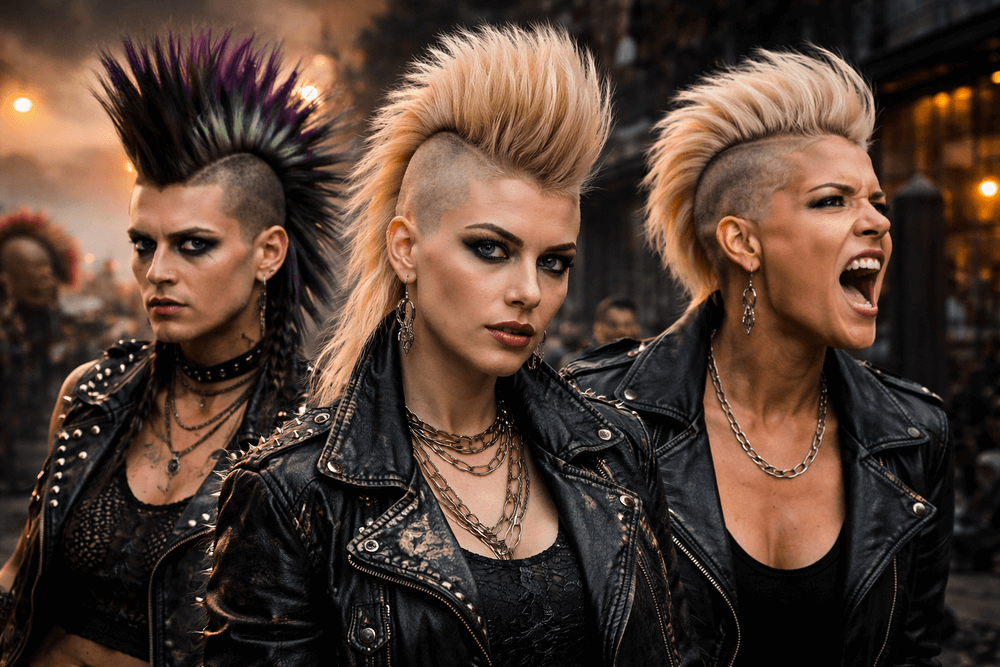
The Mohawk crossed gender lines in ways few hairstyles have. It has served as a symbol of resistance and empowerment for generations of women. In punk culture, women with mohawks challenged ideas about femininity and beauty.
Female punk icons like Wendy O. Williams of the Plasmatics wore mohawks as aggressively as any male punk. The style said women could be just as fierce, angry, and uncompromising as men. In modern times, singers like Pink and actresses like Natalie Dormer have worn mohawks, each time sparking conversations about women, power, and appearance.
From Subculture to Mainstream
The journey from punk clubs to suburban kindergartens shows how cultural meanings shift. While it still may be seen as anti-conformist, it’s been adopted by moms and dads as a cute hairstyle for their children.
Athletes started wearing mohawks in the 1990s and 2000s. Soccer player Mario Balotelli, tennis player Marcos Baghdatis, and countless NFL players sported variations. In sports, the Mohawk is seen as a symbol of strength and toughness, as well as a way to stand out on the field.
The transformation is remarkable. What once meant “I reject your society” now might mean “my kid plays youth soccer.” Parents give toddlers fauxhawks without any thought to punk rebellion or warrior tradition.
Cultural Appropriation Debates
The Mohawk sits at the center of discussions about cultural appropriation. When non-Indigenous people wear mohawks, are they stealing from Native American culture?
The answer is complicated. The hairstyle existed independently in multiple cultures – Celtic, Ukrainian, African. But in North America, the name and association are specifically tied to Indigenous peoples. Many Indigenous activists argue that wearing a “mohawk” without understanding or respecting its origins perpetuates cultural harm.
The Mohawk served as a symbol of strength, individuality, and readiness for battle. Punk Design When it becomes just fashion, that meaning gets lost.
Modern Meanings
Today’s Mohawk can mean almost anything:
- Rebellion – still the classic punk meaning
- Creativity – especially in artistic communities
- Athletic prowess – common in sports
- Fashion statement – divorced from deeper meaning
- Cultural connection – for those reclaiming heritage
- Childhood playfulness – the toddler mohawk phenomenon
- Professional edginess – the corporate fauxhawk
The multiplicity of meanings shows how symbols evolve. Cultural meanings are taken and shared, and this is globalization throughout the millennia.
Why It Endures
The Mohawk endures because it demands attention. You can’t ignore someone with a mohawk. It forces a reaction – admiration, disgust, curiosity, fear. That power to provoke keeps it relevant.
The modern Mohawk has evolved into various forms and interpretations. Each generation finds new ways to use this ancient style. From Instagram influencers with rainbow mohawks to MMA fighters with intimidating variations, the style keeps reinventing itself.
The Mohawk also endures because it’s democratic. Anyone can have one. It doesn’t require specific hair texture or length. It can be adapted to any lifestyle, from the subtle fauxhawk to the extreme liberty spikes.
The Bottom Line
The Mohawk is more than a haircut – it’s a cultural artifact that carries thousands of years of human meaning. Warriors wore it into battle. Punks wore it into rebellion. Parents put it on their toddlers for Instagram photos.
Each wearer adds to its story. A Ukrainian soldier might wear an oseledets to connect with Cossack heritage. A young woman might shave a mohawk to challenge beauty standards. A suburban kid might get a fauxhawk to feel cool at school.
The power of the Mohawk lies in its visibility. It’s a choice that can’t be hidden, a statement that demands to be seen. Whether that statement is “I’ll fight you,” “I reject your values,” or “my kid looks cute,” depends entirely on who’s wearing it and when.
In a world of conformity, the Mohawk remains defiantly vertical – a strip of hair that refuses to lie down and blend in. After millennia of human civilization, we still haven’t found a more effective way to use hair to say “look at me.” That’s quite an achievement for something that grows naturally from our heads.