
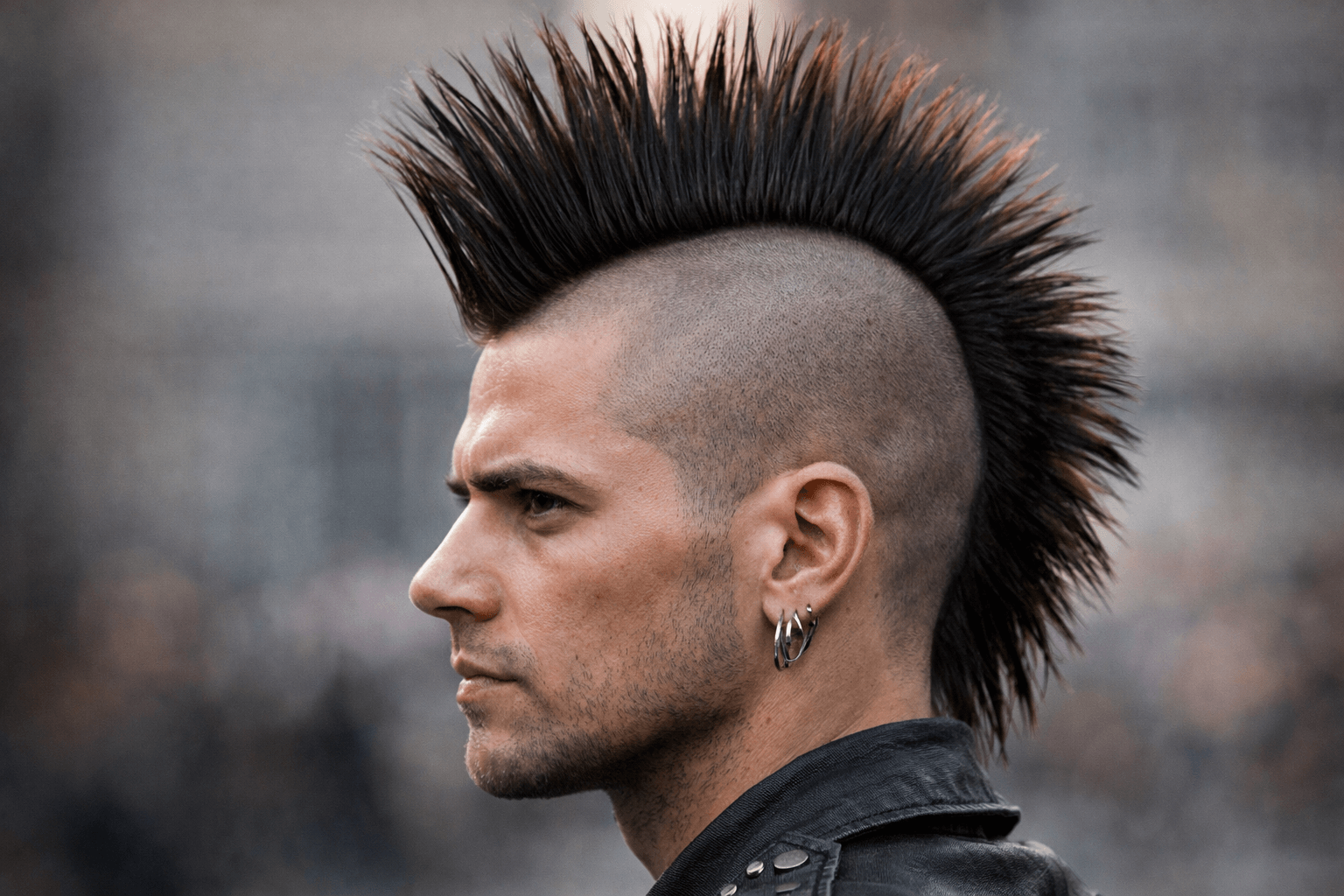
The classic Mohawk is simple in concept but bold in execution. Shave the sides of your head completely. Leave a strip of hair running from your forehead to your nape. Stand that strip straight up. That’s it – and that’s everything.
What Makes It Classic
A classic Mohawk is defined by leaving a narrow strip of upright hair running from the front to the back of the head, with the sides completely shaved. No fading, no blending, no compromise. The contrast is absolute – bare skin on the sides meets a wall of hair in the center.
The width of the strip matters. Traditional mohawks keep it narrow – about 1 to 2 inches wide. Some go as narrow as half an inch, creating a thin line of defiance down the skull. The wider you go, the less classic it becomes.
Height is the other defining feature. Classic mohawks stand tall. We’re talking 3 to 6 inches minimum, though some push it much higher. The hair stands perpendicular to the skull, creating that unmistakable silhouette that turns heads from blocks away.
How to Cut a Classic Mohawk
Getting the classic cut right requires precision. Here’s how barbers do it:
First, they section the hair. The middle section that will be left standing should be pinned with clips, away from the rest of the hair that will be either cut shorter or shaved completely to get a full Mohawk. The strip runs from the hairline at the forehead straight back to where the skull curves down at the nape.
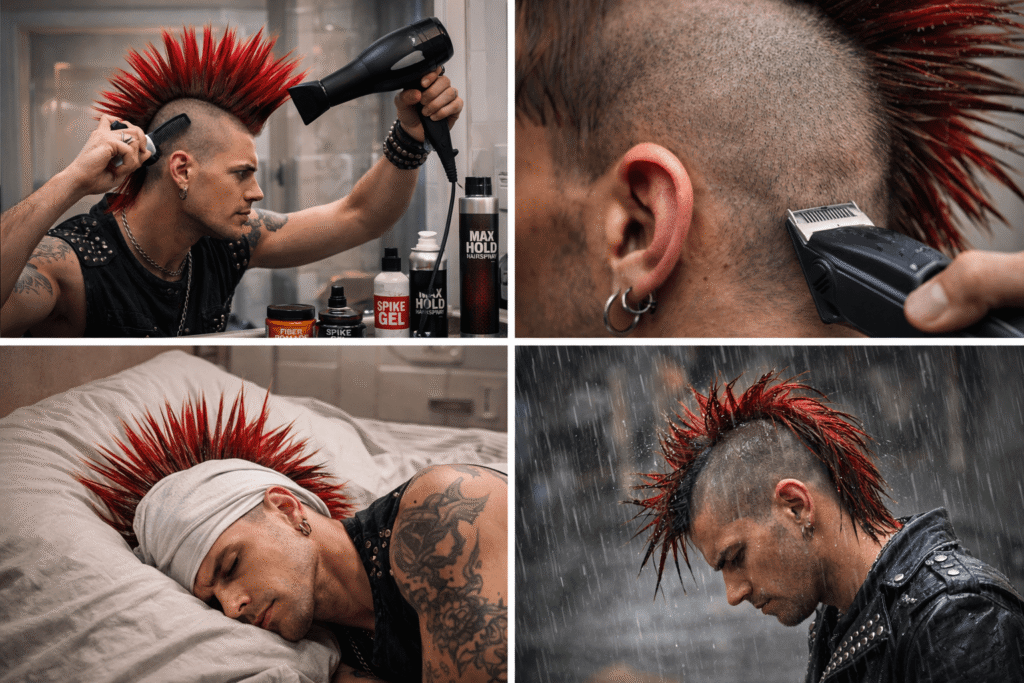
For the sides, most barbers use clippers with no guard or a #1 guard at most. For a classic mohawk, a #1 or #2 guard will give you a close shave, while a #3 or #4 guard will leave a bit more length. The goal is skin or near-skin. Start at the bottom near the ears and work upward to the parted section.
The center strip needs careful trimming. If you want the mohawk to stand up, shorter lengths (around 2 to 4 inches) are easier to spike. Consistency is key – the strip should be the same length from front to back, or slightly shorter in back to account for the skull’s curve.
Clean edges separate amateur cuts from professional ones. Barbers use clippers without guards or straight razors to define the line where the mohawk meets the shaved sides. This line should be sharp and straight.
Styling the Classic Look

The classic Mohawk demands serious product and technique. This isn’t wash-and-go hair.
The Traditional Spike Method:
Start with damp hair. Divide your long hair into 8-9 exactly equal sections and hold them with elastic bands at the scalp. Work one section at a time, starting in front. Remove each elastic and coat the section from base to tip with strong-hold gel or pomade, forming spikes with your fingers.
For maximum height, blow-dry each section while pulling it straight up. Gravity is your enemy here – you need products that fight back.
Product Requirements:
Classic mohawks need industrial-strength hold. Regular gel won’t cut it. You need:
- Fiber pomade or concrete-hold pomade for structure
- Strong-hold gel for initial shaping
- Maximum-hold hairspray to lock everything in place
- Some punks use actual glue – Elmer’s glue or specialized hair glue
This requires a stronghold hair gel or glue to keep the spikes firmly in place. The products matter because a drooping mohawk defeats the entire purpose.
The Punk Standard
The classic mohawk reached its definitive form in 1970s and 1980s punk culture. This version pushed everything to extremes:
Height: Punks competed to see who could go tallest. Six inches was common. Twelve inches happened. Some went higher.
Color: Bright, unnatural colors became standard. Neon green, electric blue, hot pink – the more offensive to mainstream sensibilities, the better.
Texture: Instead of smooth spikes, punks created jagged, aggressive points. The Fan Mohawk, characterized by its wide-spread and spiked style, is a bold statement of punk culture. Each spike was individually sculpted to look dangerous.
Width: While some kept it narrow, others created fan mohawks that spread outward as well as upward, maximizing visual impact.
Maintenance Reality
A classic mohawk is high maintenance. Here’s what you’re signing up for:
Daily styling: Plan on 20-30 minutes every morning to get the spikes right. More if you’re going for extreme height.
Weekly shaving: The sides need touching up every 3-4 days to maintain the clean contrast. Most people shave twice a week minimum.
Product buildup: With all that gel and hairspray, you’ll need clarifying shampoo regularly. Product buildup is inevitable.
Sleeping challenges: You can’t sleep on a spiked mohawk. Either restyle every morning or wrap it carefully at night.
Weather vulnerability: Rain is your enemy. Wind is worse. Humidity makes everything harder.
Face Shapes and Fit
Mohawks work surprisingly well on oval, round, and square face shapes. Oval faces suit just about any style, while a mohawk can elongate a round face and sharpen a square one by adding height and vertical structure.
The classic mohawk works best on:
- Square faces (emphasizes strong jawlines)
- Oval faces (balanced proportions handle the drama)
- Diamond faces (adds width at the top)
Round faces need careful consideration – the added height can help, but the stark sides might emphasize roundness.
The Commitment Factor
A classic mohawk isn’t a casual decision. Once you shave those sides, you’re committed for months. Growing out a mohawk is awkward – there’s no graceful transition period.
Consider your life circumstances:
- Work: Most traditional workplaces won’t accept a classic mohawk
- Social: You’ll get stares, comments, and judgment
- Activities: Helmets, hats, and hoods become problematic
- Cost: Professional maintenance adds up quickly
Variations on the Classic
While staying true to the classic formula, there are subtle variations:
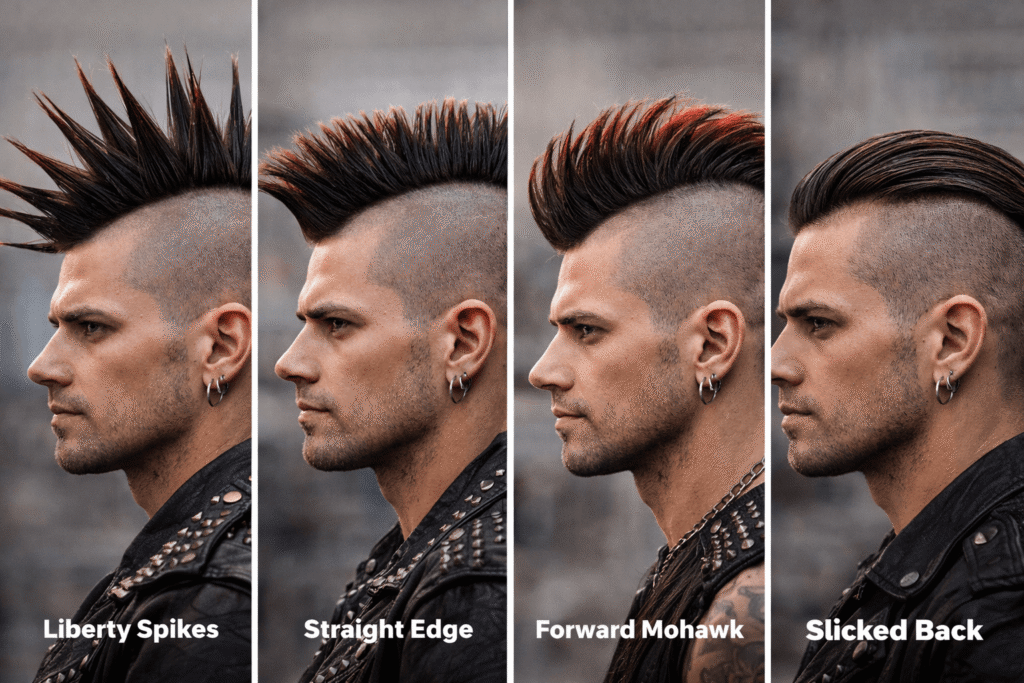
The Liberty Spikes: Individual spikes instead of a continuous wall. Coat the section from base to point with fiber pomade or concrete hold pomade to make a spike shape with your fingers.
The Straight Edge: One continuous fin of hair, smooth rather than spiked.
The Forward Mohawk: The Forward Mohawk reimagines the classic mohawk by directing the hair forward rather than upward, resulting in a wave-like crest.
The Slicked Back: For when you need to tone it down temporarily, the center strip can be slicked back with pomade.
Historical Accuracy
The “classic” mohawk as we know it is actually a modern invention. The Mohawk did not shave their heads when they created this square of hair, but they rather pulled the hair out in small tufts at a time.
The punk version that became “classic” in popular culture is a hybridization of various warrior hairstyles, filtered through Hollywood misrepresentation and punk rebellion. It’s classic in the sense that it defined an era, not because it’s historically authentic.
Who Wears It Now
Today’s classic mohawk wearers fall into distinct categories:
True Punks: Keeping the tradition alive with full commitment to height, color, and attitude.
Weekend Warriors: Professional during the week, mohawked on weekends.
Musicians: Especially in punk, metal, and alternative scenes.
Athletes: Particularly in combat sports where intimidation matters.
The Bottom Line
The classic Mohawk is uncompromising. It’s not trying to fit in or look professional. It’s not a hairstyle you can halfway commit to. The mohawk is loud, proud, and unapologetically bold. It signals someone who’s confident, creative, and not afraid to break the mold.
If you want a mohawk but need something more flexible, consider the modern variations – faux hawks, mohawk fades, or short mohawks. They capture some of the spirit without the full commitment.
But if you’re ready to shave those sides clean, spike that center strip toward the sky, and deal with everything that comes with it, the classic mohawk is waiting. Just understand what you’re getting into. This isn’t just a haircut. It’s a declaration of war against conformity, armed with hair gel and attitude.
The classic mohawk says you don’t care what anyone thinks. Make sure that’s true before you pick up the clippers.