
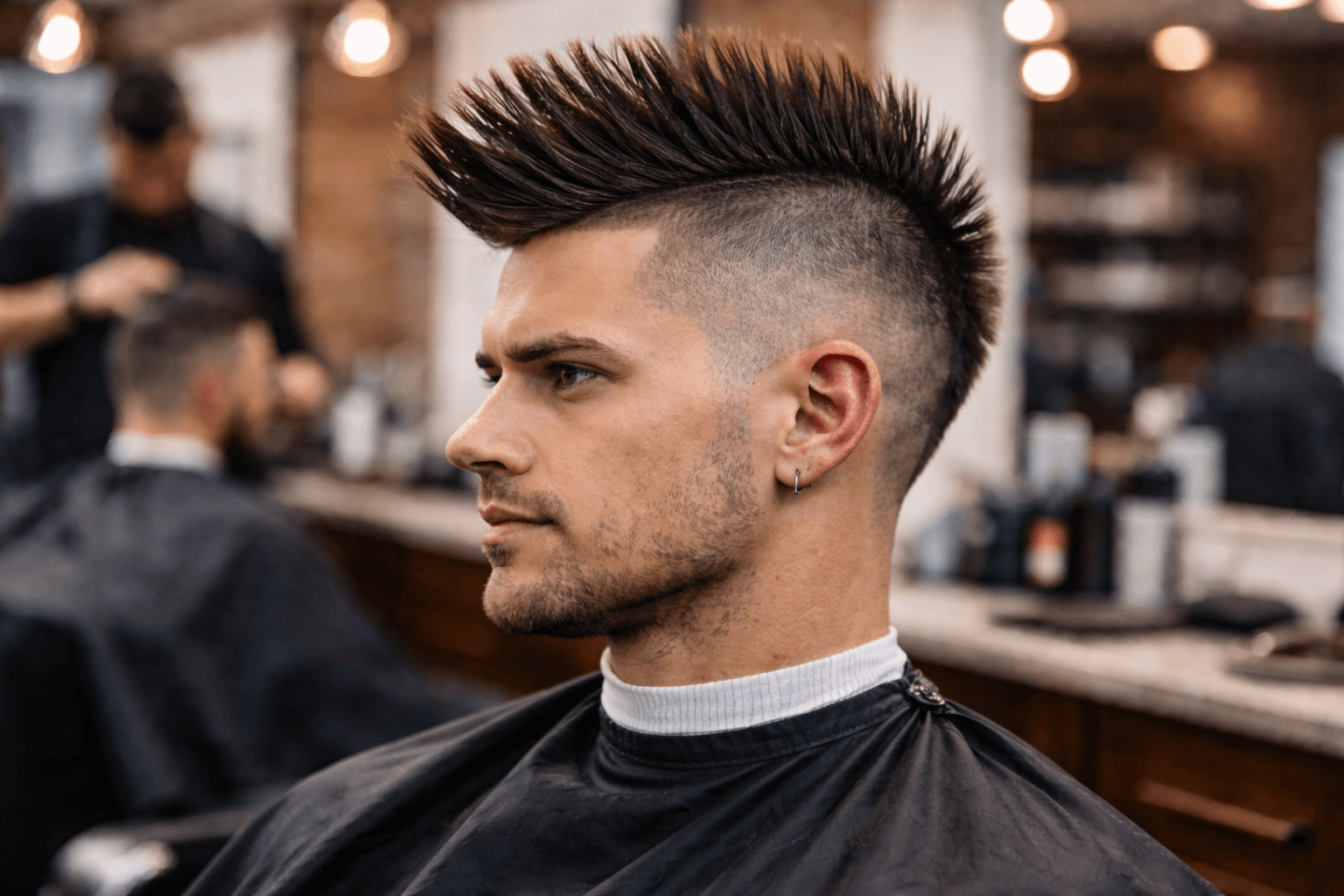
The fade mohawk changed everything. It took the rebellious mohawk and made it wearable for the rest of us. By blending the shaved sides into a gradient, the fade mohawk created a style that works in boardrooms, classrooms, and barbershops worldwide.
What Makes It Different
A hybrid hairstyle that combines the traditional Mohawk – a strip of longer hair down the center of the head with a fade, where the sides and back are gradually tapered down to shorter lengths or the skin. That gradual taper is everything. Instead of the harsh line between shaved sides and standing hair, the fade creates a smooth transition.
The fade mohawk keeps the central strip of longer hair but loses the aggression. Where classic mohawks scream rebellion, fade mohawks speak confidence. They’re bold without being confrontational, edgy without being unemployable.
The Anatomy of a Fade
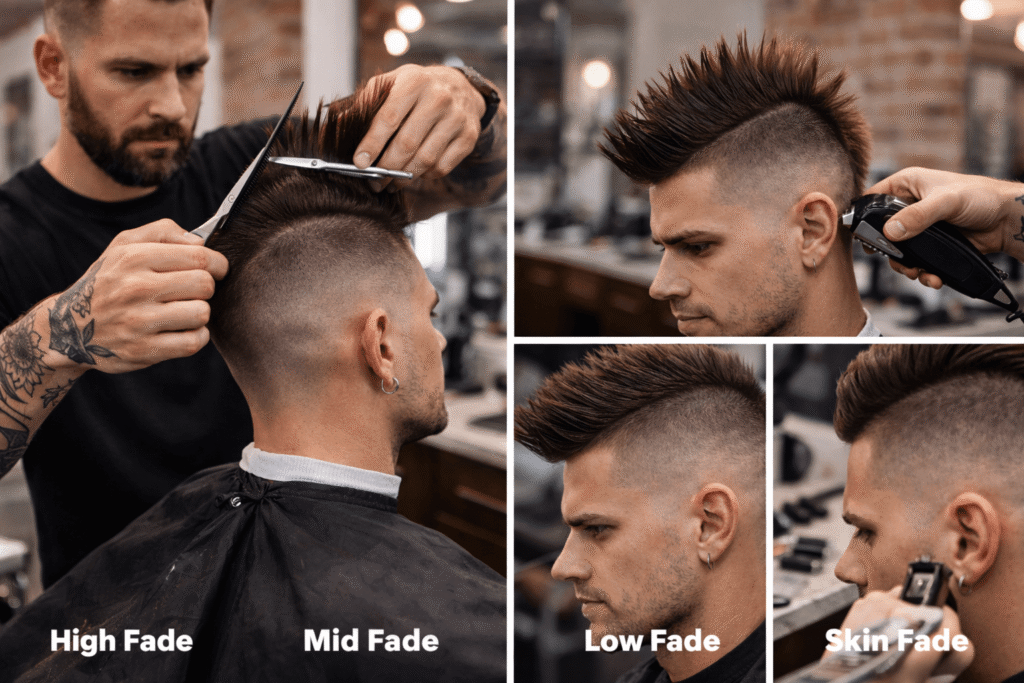
Understanding fade terminology helps you get what you want:
High Fade: The fade starts above the temples, close to the top of the head. This creates maximum contrast and drama.
Mid Fade: Begins around temple level. The mid-fade mohawk strikes a perfect balance between versatility and individuality, making it a great choice for those who want to showcase their personal style while also adhering to professional requirements.
Low Fade: Starts just above the ears. More subtle, more conservative, easier to grow out.
Skin Fade: Tapers down to bare skin at the bottom. Clean, sharp, requires frequent maintenance.
Taper Fade: A gentler gradient that never goes to skin. It can be made to be more conservative by creating more of a taper on the sides so the hair is more uniform in length throughout.
Popular Fade Mohawk Variations
The Burst Fade Mohawk
In 2026, the burst fade Mohawk stands out as the trendiest and most versatile Mohawk haircut. Its circular fade pattern radiating from behind the ears pairs perfectly with textured tops. The burst fade curves around the ear rather than going straight up, creating a semicircle effect that emphasizes the mohawk’s shape.
The Drop Fade Mohawk
The fade literally drops behind the ear, following the head’s natural curve. The drop fade mohawk allows you to embrace the punk-rock aesthetic without the exaggerated height of a traditional mohawk. This creates a more organic flow and works especially well with longer mohawks.
The Disconnected Fade Mohawk
The Disconnected Mohawk Fade presents a visual statement by sharply juxtaposing lengths, where the top is significantly longer than the bald or skin-faded sides. Instead of blending smoothly, there’s a deliberate line between the top and the fade. It’s bold but controlled.
The Taper Fade Mohawk
The most conservative option. When the hair on the sides is blended into the longer center, hip folk call it a taper fade mohawk. The sides gradually shorten without dramatic contrasts. Perfect for first-timers or professional environments.
Styling Options
The fade mohawk’s versatility shows in its styling options:
The Textured Top: Leave the center strip messy and natural. Use sea salt spray or texture powder for a lived-in look.
The Slicked Back: The Slick Back Mohawk Fade merges the boldness of tradition with polished, slicked-back styling. Professional enough for business, edgy enough for after-hours.
The Spiked Version: Shorter spikes than a classic mohawk, but still vertical. Use strong-hold gel for definition without extreme height.
The Curly Mohawk Fade: Pairing your curly mohawk with a low to mid fade can enhance the overall appearance and make your hair appear fuller. Natural texture does the work – just enhance with curl cream.
The Forward Sweep: Style the center strip forward for a modern, fashion-forward look. Works best with medium-length tops.
Face Shape Considerations
For men with an oval face shape, almost any style will prove flattering. A high fade adds definition and height, perfectly complementing the naturally balanced proportions.
Square Faces: To soften these lines, opt for a medium or low fade that starts closer to the ear. Avoid high fades that emphasize angular features.
Round Faces: High fades work well, adding vertical length to balance proportions.
Diamond Faces: Mid to low fades prevent the style from making the face appear too narrow.
The Technical Cut
Creating a proper fade mohawk requires skill:
Russell begins with scissor over comb to carve clean lines along the sides and behind the ears, laying the foundation with graduation. From there, he transitions to clippers to taper and fade the hair to skin.
The process typically involves:
- Sectioning the mohawk strip (wider than classic, usually 2-3 inches)
- Creating the initial guide lines
- Establishing the fade height
- Blending with multiple clipper guards
- Detailing with trimmers
- Texturizing the top for movement
Maintenance Requirements
Regular trims are crucial to keep your fade sharp and well-blended. This ensures the contrast between the top and sides remains crisp and polished.
Touch-ups: Every 2-3 weeks for the fade to stay fresh. The lower the fade, the more frequently it needs attention.
Daily Styling: 5-10 minutes depending on your chosen style. Much less demanding than a classic mohawk.
Products: Varies by style – pomade for slick looks, clay for texture, gel for definition.
Home Care: Use a razor to define edges for a crisp line. Many maintain their edges between barber visits.
Cultural Evolution
The fade mohawk represents the mohawk’s journey from counterculture to mainstream. In the 80s, Mohawk fade haircuts were a sign of punk culture and customarily featured dyed hair that is styled as stiff peaks. Today, they’re worn by everyone from athletes to accountants.
It saw a resurgence in the early 2000s with athletes and celebrities and again in the 2020s, particularly with faded variations like the burst fade Mohawk. David Beckham popularized the fauxhawk variation. Cristiano Ronaldo made the fade mohawk a soccer standard.
Professional Acceptability
The fade mohawk cracked the code on making mohawks workplace-appropriate:
Some styles, such as a taper fade or undercut mohawk, can be made to be more polished-looking and, therefore, perfect for the workplace.
Key factors for professional settings:
- Keep the fade neat and well-maintained
- Avoid extreme height on top
- Style conservatively for work
- Choose natural hair colors
- Opt for taper or low fades over high skin fades
For Different Hair Types
Straight Hair: Requires product to add texture and hold. Works well with all fade variations.
Wavy Hair: The textured waves through the crown give natural movement, while the skin fade on the sides keeps the look fresh and defined.
Curly Hair: Natural volume creates fullness without excessive styling. Low to mid fades work best.
Coarse Hair: Holds shape well. Can handle high fades and dramatic contrasts.
Fine Hair: Benefits from gradual tapers rather than harsh fades. Texture products add necessary volume.
The Modern Standard
Today’s fade mohawk is less about rebellion and more about style. It’s a choice for trendsetters who seek something fresh that isn’t overly wild. It signals someone who appreciates both tradition and innovation.
This edgy cut features a strip of hair extending from the top to the nape area accentuated by shaved sides. But unlike its predecessor, it does so with sophistication.
Kids and Fade Mohawks
For kids or toddlers, terms like “kids Mohawk fade” or “toddler Mohawk fade” are popular to denote age appropriate adaptations. Parents love fade mohawks because they’re cool enough for kids but appropriate enough for school.
The fade makes all the difference – it transforms what could be seen as aggressive into something playful and stylish.
DIY vs. Professional
While classic mohawks can be DIY projects (shave the sides, leave the middle), fade mohawks require professional skill. The blending is everything. This haircut has a limitless variation of styles from a more conservative to edgy look depending on the desired results.
A good barber can adjust:
- Fade height and gradient
- Top length and texture
- Edge sharpness
- Overall balance
The Investment
Fade mohawks cost more to maintain than classic cuts but less than traditional mohawks:
Initial Cut: $30-60 depending on location and barber skill Maintenance: $20-40 every 2-3 weeks Products: $20-50 monthly Time: 30-45 minutes per barber visit, 5-10 minutes daily styling
The Bottom Line
The fade mohawk democratized the mohawk. It took a hairstyle that meant “I reject your society” and transformed it into “I have style and confidence.” The Mohawk fade’s adaptability makes it a key player in modern barbering, empowering people across ages and backgrounds to showcase their personality through hair.
This isn’t a watered-down mohawk – it’s an evolution. The fade adds sophistication without sacrificing edge. It provides options without losing identity. Most importantly, it makes the mohawk accessible to people who want to stand out without dropping out.
Whether you choose a burst fade for maximum style, a taper fade for subtlety, or a skin fade for sharpness, the fade mohawk offers something the classic never could: the ability to be bold on your own terms. In a world that increasingly values both individuality and professionalism, the fade mohawk found the sweet spot.
The classic mohawk says “look at me.” The fade mohawk says “look at me, I’ve got this figured out.”