Faded Mohawk: Every Type of Fade Explained
The faded mohawk is the most searched haircut in this entire category — by a wide margin. Over 74,000 people look it up every month, and that number has held steady for years. The reason isn't hard to figure out: the fade transformed the mohawk from a subculture badge into something any guy can actually wear. It made the cut clean, modern, and adaptable without stripping out what makes it interesting in the first place.
This guide covers everything — the four main fade types and what distinguishes them, every significant variation from the semi mohawk to the undercut and tapered styles, how to communicate exactly what you want at the barbershop, which style works for your hair type and face shape, how to actually style the strip at home, and which products do the job right. By the end, you'll have a sharper picture of this cut than most guys who've been wearing it for years.
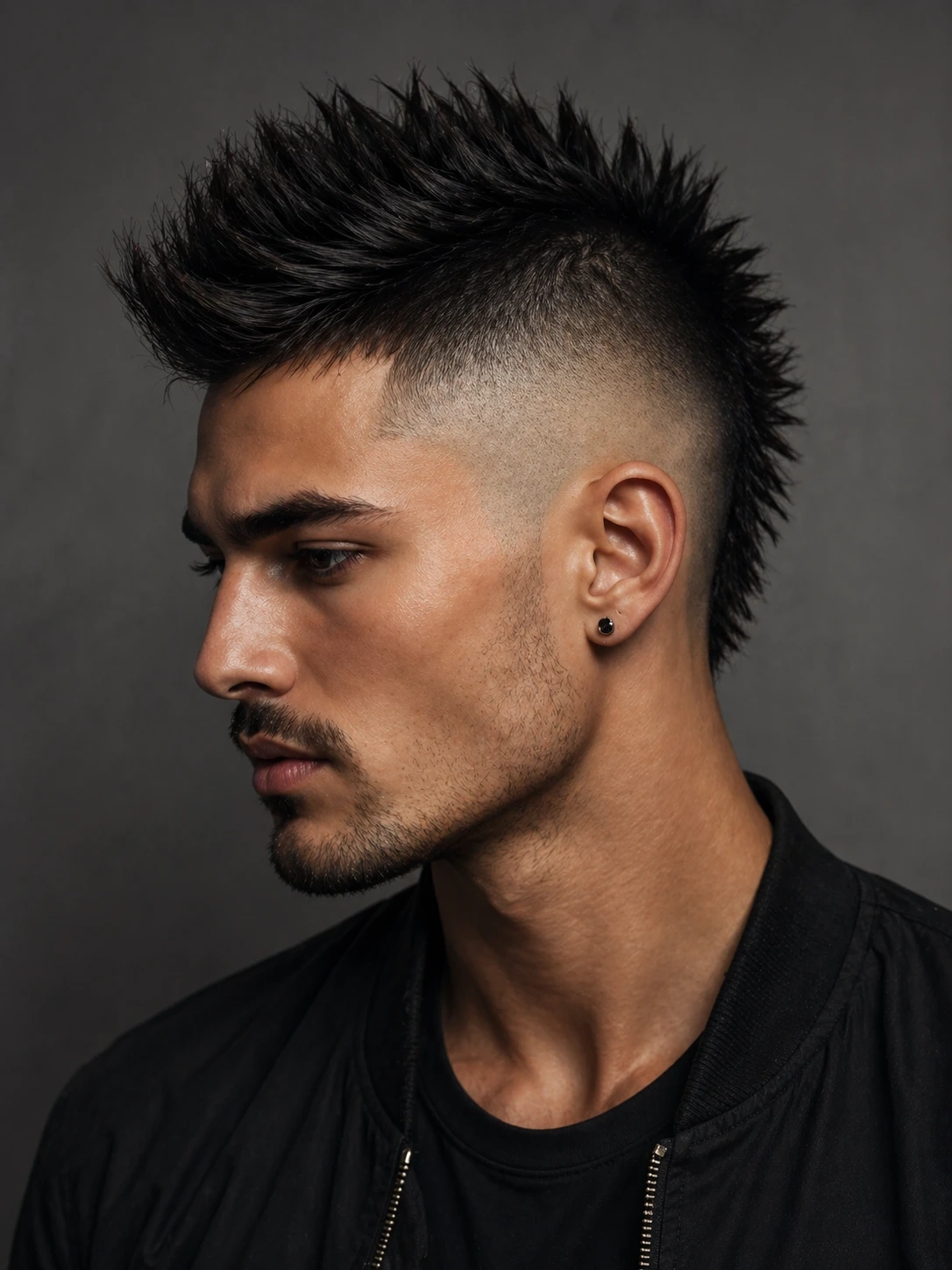
What Makes a Mohawk "Faded"
Before getting into the variations, it helps to understand what "fade" actually means in barber language — because it gets used loosely and sometimes interchangeably with terms it doesn't quite match.
A fade is a clipper technique where the hair length gradually decreases as you move down the sides of the head. At the top of the fade zone, hair is relatively longer. At the base — near the skin — it's either very short or completely gone. The transition between those two lengths is the fade itself: seamless, smooth, no visible step or line between one length and the next.
On a mohawk, the fade is applied to the sides. The central strip — running from the forehead to the nape of the neck — is left longer and becomes the visual centerpiece. The fade on the sides can start high (close to the top of the head) or low (just above the ear), and it can end at skin or stop at a very short guard.
Where the fade starts and where it ends is what defines the four types: low, mid, high, and skin.
The Four Core Faded Mohawk Types
1. Low Fade Mohawk
What it looks like: The fade zone is compact — sitting in the bottom inch or two of the sides, just above the ear and above the neckline. Above that narrow band, the sides stay at a moderate length, typically a 2 or 3 guard. From a distance, the sides look full. Up close, the clean fade at the base shows deliberate work. The contrast between the sides and the central strip is present but not dramatic.
Who it's for: Guys who want something intentional without broadcasting it. The low fade mohawk is the most conservative version of the cut. It works in professional environments, suits fine hair where a higher fade would make the sides look too bare, and is the right starting point for someone trying a mohawk for the first time.
Grow-out behavior: The best of the four. Because the fade zone is a small band at the bottom, the sides don't look messy quickly as hair grows back. Most guys can stretch visits to 3 to 4 weeks without the cut looking neglected.
What to say: "Low fade mohawk — keep the sides above the ear at a 2 guard, fade the bottom down to skin or close to it."
2. Mid Fade Mohawk
What it looks like: The fade starts around the temple and mid-ear level. The lower half of the sides goes from skin up to a 1 or 2 guard before blending into the longer hair above. From the front, the contrast is clearly visible. From the side, the fade creates a smooth arc that wraps from the temple toward the neckline. It's the most commonly requested variation and the one that shows up most in barbershop portfolios — versatile enough to look right in most contexts, bold enough to actually read as a mohawk.
Who it's for: Broadly — most face shapes, all hair textures, most lifestyle situations. The mid fade hits a balance between dramatic and everyday that makes it the default recommendation for anyone unsure where to start.
Grow-out behavior: Stays sharp for 2 to 3 weeks. After that the fade softens, but it doesn't look bad — some guys prefer the slightly grown-out version as the weeks pass.
What to say: "Mid fade mohawk — fade starts at the temple, drop it to skin on the sides, leave about two inches on top."
3. High Fade Mohawk
What it looks like: The fade begins at or above the temples, leaving the central strip looking almost elevated — the sides are extremely short for such a large portion of the head that the strip appears to rise above otherwise bare scalp. This is a bold, unmistakable look. Nobody sees a high fade mohawk and wonders whether it was intentional.
Who it's for: Oval and diamond face shapes handle this best. Strong jawlines benefit from the high contrast. Men with darker hair or high-contrast color get the most visual impact because the fade reads most sharply. It also works exceptionally well on coily and kinky natural hair, where the contrast between bare skin and the textured central strip is particularly striking.
Grow-out behavior: Demands the most maintenance. Visible regrowth appears within 10 to 14 days. If you want the sharp lines to hold, plan on visiting the barber every 2 weeks. If you don't mind a slightly softer look in the third week, every 3 weeks is manageable.
What to say: "High fade mohawk — I want the fade to start above the temples, take the sides down to skin. Central strip at around two and a half inches."
4. Skin Fade (Bald Fade) Mohawk
What it looks like: The sides go all the way to the scalp — zero hair, bare skin, clean contrast. The skin fade can start at any level (low, mid, or high), but what defines it is the endpoint: visible scalp. Combined with a styled central strip, this is the maximum-contrast version of the faded mohawk. On darker hair the difference between scalp and strip is visually powerful. On lighter skin and hair, the effect is slightly softer but still deliberate and sharp.
Who it's for: Men who want the crispest version of the cut. Men with darker hair where the bare skin reads most clearly. Men with coily or afro-texture hair — a skin fade is one of the cleanest things a barber can do on these textures. Also works particularly well for men with a receding hairline because the bare sides look intentional rather than like a hairline fighting itself.
Maintenance reality: The highest-maintenance of the four. Skin fades start showing stubble in a week. Most men with this version are back in the chair every 10 to 14 days to keep the sides clean.
What to say: "Skin fade mohawk — bald on the sides, down to the skin. Central strip stays at [X inches]."
All Four Types Side by Side
| Fade Type | Fade Starts At | Side Length at Base | Visual Weight | Maintenance |
|---|---|---|---|---|
| Low fade | Just above ear / neckline | Skin or 0.5 guard | Subtle — reads polished up close | Every 3–4 weeks |
| Mid fade | Temple / mid-ear | Skin or 0 guard | Moderate — clearly deliberate at any distance | Every 2–3 weeks |
| High fade | Above temples | Skin | Bold — unmistakable | Every 2 weeks |
| Skin (bald) fade | Any starting point | Bare scalp | Maximum — the sharpest version | Every 1–2 weeks |
Beyond the Four: Related Styles Worth Knowing
Semi Mohawk
The semi mohawk is the faded mohawk pulled back from the edge. The sides aren't faded to skin or even a 1 guard — they stay at a 2 or 3, noticeably shorter than the top strip but with enough length that they don't disappear. The central strip runs 2 to 3 inches and can be spiked up with product or combed flat.
The appeal is adaptability. When you want the mohawk shape, five minutes with product delivers it. When you don't — a job interview, a formal event, a day when you just don't feel like it — combing the strip flat reads as a perfectly normal haircut. Same cut, two modes.
Semi vs. regular faded: The sides are the difference. A regular faded mohawk takes the sides to skin or very close. A semi keeps them at 2 to 3 guard. The contrast is softer, the look is more conservative, the flexibility is higher.
What to say: "Semi mohawk — keep the sides at a 2, fade down slightly at the bottom but don't go to skin. Top strip around 2 inches, I want to be able to wear it flat some days."
Tapered Mohawk
A taper and a fade are different techniques that get confused often. A taper shortens the hair only around the perimeter — the neckline and slightly at the sides — while leaving the rest of the sides at moderate length. A fade removes hair in a broader gradient zone.
The tapered mohawk uses this softer technique on the sides. The result looks less like a barbershop statement and more like a conventional haircut where the center strip happens to be more prominent. It's the subtlest version of the shape — recognizable as a mohawk to people who're looking, and just a clean professional cut to everyone else.
Best for: Professional or conservative settings. Men who want the structural shape without any aggressive contrast. Also ideal for very fast-growing hair — the taper grows out the most gracefully of any variation.
Undercut Mohawk
An undercut creates a hard disconnection rather than a gradient. Below a certain line, hair is very short. Above it, hair stays at full length. The transition is sharp and visible — it's deliberately not blended.
On a mohawk, the undercut makes the central strip look like it sits on top of a clearly defined ledge. The geometry is architectural and fashion-forward. It looks more editorial than barbershop-classic.
Undercut vs. faded: A fade blends. An undercut disconnects. If you want something that looks engineered and intentional — more high-fashion than traditional — the undercut is the direction. Works best on thick hair where the disconnection line reads cleanly.
Buzz Cut Mohawk
Both the central strip and the sides are cut with clippers, just at different guard lengths. No spiking, no styling product required. The strip might sit at a 4 guard while the sides are a 0 or 1. The shape reads as a mohawk but the overall length is uniformly short across the whole head.
This is the lowest-commitment version of the faded mohawk. No daily styling routine. Grows out cleanly. Works equally well on thinning hair, fast-growing hair, and every texture.
Which Fade Works for Your Hair Type
| Hair Type | Best Fade | Why | Watch For |
|---|---|---|---|
| Straight / fine | Low or mid | High fades on fine hair make the strip look thin | Keep strip at moderate length for apparent fullness |
| Straight / thick | Any — high looks especially clean | Thickness creates natural volume and holds a spike | Strong-hold product keeps spike from drooping |
| Wavy | Mid fade | Waves add texture and movement without effort | Let the wave work for you, minimize heavy product |
| Loose curly (3a–3b) | Mid or high | Curl pattern gives the strip natural shape | Avoid heavy gels that clump individual curls |
| Tight curly (3c–4a) | High or skin | Defined curls against clean skin — striking contrast | Barber needs curl-fade experience |
| Coily / 4b–4c | High or skin | Coil pattern holds volume and structure naturally | Keep the strip moisturized — coily hair dries faster |
| Loc'd hair | Skin fade | Bare sides make the loc strip the focal point | Fade edges need to be crisp — locs are unforgiving |
| Thinning / receding | Buzz cut or skin fade | Removes thin areas intentionally; looks deliberate | Shorter strip looks denser than a long one |
Faded Mohawk for Different Face Shapes
The mohawk adds vertical height to the top of the head. How much height, and from where, affects how the face reads.
Oval: The most flexible shape — every variation works without adjustment. Oval faces carry tall strips, low fades, high fades, and everything in between without anything looking off.
Round: The faded mohawk is genuinely flattering here. The vertical strip creates visual length, and a mid or high fade reduces the apparent width of the sides. Go taller with the strip than you might instinctively think — it works in your favor.
Square: Works but requires some care. A mid fade is safer than a high fade, which can make a square jawline look angular and heavy. Keep the strip at a moderate length rather than very tall. Avoid hard undercut lines that mirror the geometry of the jaw.
Heart (wide forehead, narrow chin): Mid fade over high. A high fade starting above the temples exaggerates the already-wide forehead. Medium strip height, not extreme.
Long / Oblong: Handle carefully. A tall strip adds more length to an already-long face. Keep the strip at 1 to 1.5 inches, styled flat or just slightly raised. A low or mid fade balances the proportions better than a high fade would.
Diamond: High fades look excellent here. The face has width in the right zone to carry the contrast. A medium-length strip with a high skin fade is one of the strongest combinations for this shape.
What to Tell Your Barber: The Exact Script
Most miscommunication at the barbershop comes from vague language, assumed understanding, or no reference photo. Here's how to eliminate all three.
Step 1 — Name the fade level. Start here, before anything else. "Low fade," "mid fade," "high fade," or "skin fade" tells the barber where the fade begins and how aggressive the contrast will be. This one phrase sets the whole structure.
Step 2 — Specify how short the sides go. "Down to skin," "down to a 1 guard," "down to a 0.5" — these are clear. "Really short" is not. If you're not sure what guard numbers mean, say "almost to the skin but not quite" or "I can still see a little bit of hair on the sides." That's also clear enough.
Step 3 — Describe the central strip. Length in inches. Width if you have a preference — most barbers default to 2 to 3 inches. Whether you want the edges of the strip sharply defined or left natural. Whether you want the strip tapered at the back neckline or kept the same width all the way down.
Step 4 — Tell them how you style it. "I spike it up" versus "I wear it flat most days" changes how the barber handles the front edge of the strip and how much length they leave. It's one sentence but it makes a real difference.
Step 5 — Show a photo. A reference image removes the remaining ambiguity. It doesn't need to be your ideal final outcome — just something showing roughly the fade level and strip length you have in mind. Pull it before you sit down.
Complete example of a clear request: "Mid fade mohawk, skin on the sides, two inches on top, I usually spike it up. Here's a reference photo." That's it. That's all you need.
Styling at Home: From Barbershop to Every Day
Getting the cut is half the equation. Here's how to handle the other half.
Short Strip (1–2 inches) — Flat or Slightly Textured
The easiest version to maintain. The short strip doesn't require much.
- Towel-dry after washing — not too dry, not dripping.
- Work a small amount (pea-sized) of matte pomade or fiber through the strip, from roots to tips.
- Use fingers or a comb to push the hair into the direction you want — forward, back, or slightly upward.
- Done. The strip holds where you put it without further effort.
Products that work here: American Crew Fiber (matte, medium-high hold), Layrite Natural Matte Cream (flexible, reworkable through the day), Kevin Murphy Easy Rider (low hold, natural finish for wavy or textured strips).
Medium Strip (2–3 inches) — Styled Upward
- Apply strong-hold gel or pomade to damp — not wet — hair.
- Work the product through the entire strip from roots to tips, not just the surface. Product that only coats the outside doesn't provide root lift.
- Using fingers or a medium brush, push the hair upright from front to back through the strip.
- Blow-dry on medium heat while keeping the hair upright. Keep the dryer moving — hold it too long in one spot and you'll burn the product. This step is what locks the shape.
- Once fully dry, use a fine-tooth comb to clean the edges of the ridge.
- Finish with a light-hold hairspray misted from 8 to 10 inches if you need all-day hold in heat or humidity.
Products: Got2b Glued Spiking Glue (maximum hold, wet shine), Layrite Superhold Pomade (high hold, semi-shine, easier to work with than Got2b), Suavecito Original (medium hold, reworkable mid-day).
Long Strip (3+ inches) — Full Spike
- Shampoo and condition the strip. Healthy, moisturized hair holds a spike better than damaged hair and is less prone to breaking under the stress of vertical hold.
- Towel-dry. Apply strong-hold gel generously — you need full coverage from root to tip on every section you want to stand up.
- Blow-dry on high heat while sculpting upright. Use both hands: one to lift sections from the root, one to shape the tip. Work in sections rather than trying to lift the whole strip at once.
- Let it cool completely before touching it again. Hair sets its shape during the cooling phase, not while it's warm.
- Once cool, mist hairspray lightly from a distance to lock without adding weight.
Products: Got2b Glued Spiking Glue (the standard for a reason), Gatsby Spiky Edge (matte finish, strong hold), Kenra Platinum Silkening Mist as a finishing layer.
Curly or Coily Strip — Natural Texture
- Apply curl cream or leave-in conditioner to the damp strip while hair is still wet.
- For defined coils: rake curl-defining gel through the strip, then diffuse with low heat or air-dry.
- For looser texture: scrunch in a light mousse and air-dry.
- Don't touch the hair while it's drying — manipulating curl patterns mid-dry creates frizz.
- The faded sides handle themselves.
Products: SheaMoisture Curl Enhancing Smoothie, Cantu Curl Activator Cream, Eco Style Olive Oil Gel for maximum definition and hold.
Product Comparison: Choosing What Fits Your Length
| Product | Hold Level | Finish | Best For | Water Soluble |
|---|---|---|---|---|
| Got2b Glued Spiking Glue | Maximum | Wet / glossy | Long spikes, maximum rigidity | Warm water |
| Layrite Superhold Pomade | High | Semi-shine | Medium strips, clean styling | Warm water |
| American Crew Fiber | Medium-high | Matte | Short strips, natural texture | Normal shampoo |
| Suavecito Original | Medium | Semi-shine | Everyday wear, reworkable | Normal shampoo |
| Gatsby Spiky Edge | High | Matte | Textured spikes, less wet look | Warm water |
| Kevin Murphy Easy Rider | Low-medium | Natural | Wavy and curly strips, soft texture | Normal shampoo |
| Cantu Curl Activator | Medium | Natural | 4a–4c strips, curl definition | Normal shampoo |
Maintenance Between Barber Visits
The central strip requires relatively little between appointments. The fade is the part that needs attention.
How long each fade type holds:
- Skin fade: visible stubble within 10 days. Plan every 10 to 14 days.
- Mid fade: clean for 2 weeks, still presentable at 3.
- Low fade / taper: looks sharp for 3 weeks, acceptable at 4.
Caring for the central strip:
- Short strips (1–2 inches): low maintenance — a basic shampoo-and-condition routine is enough.
- Medium strips (2–3 inches): avoid over-washing. Two or three times a week is plenty. Daily washing strips the oils that keep hair strong enough to hold a style.
- Long strips (3+ inches): use a moisturizing conditioner every wash. A weekly deep conditioner or hair mask keeps the longer sections from getting dry and brittle, which matters because dry hair doesn't hold a spike as reliably and is more prone to breaking.
- Coily and natural-texture strips: apply a light oil or leave-in conditioner daily or every other day. Coily hair loses moisture faster than straight or wavy textures.
Trimming at home:
If you're comfortable with scissors, cleaning up the length of the strip between visits is straightforward — small amounts at a time, never more than you intend to remove. Never try to clean up the fade yourself unless you have experience with clippers. An uneven fade is harder to fix than a slightly overgrown one.
Common Mistakes and How to Avoid Them
1. Saying "short mohawk" and getting something unexpected.
"Short" is relative. Barbers hear it relative to their mental default, which might not match yours. Always give length in inches. "Short mohawk, strip at about 1.5 inches" cannot be misunderstood.
2. Getting the strip width trimmed down too much.
Some barbers edge the strip narrower during cleanup, especially on shorter strips. Tell them upfront: "Keep the strip width at X inches, don't narrow it." Measure your existing width before the appointment if you need a reference.
3. Using too much product and weighting the spike down.
More product doesn't always mean more hold — it can mean more weight, which causes drooping. Start with less than you think you need. Add more only if the hold isn't there. Over-product is much harder to fix than under-product.
4. Washing with cold water.
Strong-hold products, especially Got2b Glued, need warm water to dissolve. Cold water leaves residue that dulls the hair and causes buildup. Warm water for washing, clarifying shampoo once a week if you style frequently.
5. Skipping neckline cleanup.
The neckline is where faded mohawks often look unfinished. Ask your barber explicitly: "Clean up the neckline — square it off or round it, either works." Don't let them leave the natural hairline at the nape untouched. It's the detail that separates a sharp cut from a sloppy one.
Explore More Men's Styles
- Modern Mohawk Haircut: 30+ Fresh Ideas for Men
- Buzz Cut Mohawk: The Clean Shaved-Sides Look
- Mohawk With Beard: Combinations That Work
- Viking Mohawk: Norse-Inspired Braided Styles
- Types of Mohawk Haircuts: A to Z Visual Guide
- Back to Men's Mohawk Hairstyles
FAQ
What is the difference between a faded mohawk and a regular mohawk?
A regular mohawk cuts the sides to one uniform short length — no gradient, no transition between lengths. A faded mohawk uses progressive clipper guards to create a smooth gradient: shorter at the base of the sides, slightly longer moving up toward the strip. The result looks more refined and grows out more gracefully. It's why the faded version has become the dominant modern interpretation of the cut.
How often do you need to trim a faded mohawk?
It depends on the fade type. A skin fade shows stubble within 10 to 14 days — plan on every 1 to 2 weeks. A mid fade stays sharp for 2 to 3 weeks. A low fade or taper can stay presentable for 3 to 4 weeks. The strip only needs trimming when you want to control its length — otherwise let it grow while you touch up the sides on their own schedule.
Can you get a faded mohawk with curly hair?
Yes, and it looks excellent. Curly and coily hair creates natural volume and texture in the strip without any product, so you get visual impact with minimal effort. A mid or high skin fade against tight curls or 4c coils creates striking contrast. The one thing to confirm: your barber should have experience fading coily or kinky textures specifically, since the technique differs significantly from fading straight or wavy hair.
What is a semi mohawk?
A semi mohawk keeps the sides at a moderate length — typically a 2 or 3 guard — rather than fading them to skin or very short. The contrast between sides and strip is softer. The advantage is flexibility: spike the strip up for a clear mohawk shape, or comb it flat or to the side when you need a more conventional look. It's the most adaptable and professionally appropriate version of the cut.
What do I say to get a faded mohawk at the barbershop?
Lead with the fade level: low, mid, high, or skin. Specify side length: "down to skin," "down to a 1 guard," or similar. Describe the strip: length in inches and how you typically style it. Bring a reference photo. A complete, clear request: "Mid fade mohawk, skin on the sides, two and a half inches on top, I spike it up — here's a reference." That covers everything the barber needs.
Does a faded mohawk work for a receding hairline?
Yes, and it can be a genuinely good choice. A high fade or skin fade removes the receding zones deliberately rather than trying to work around them, which looks intentional rather than like you're hiding something. All the visual attention redirects to the central strip, which is exactly what you want. A buzz cut mohawk — short all over with different lengths between strip and sides — is particularly clean and confident-looking on a thinning or receding hairline.