Female Mohawk Hairstyles: Every Style for Women
More women search for mohawk hairstyles than most people realize. The query "female mohawk haircut" alone generates over 8,100 searches every month — and that's before counting the dozens of related searches: ladies mohawk, mohawk for women, mohawk hair styles for ladies, short mohawk for women, black female mohawk. Stack the whole cluster together and you're looking at well over 50,000 monthly searches across women's mohawk styles.
The reason is simple: this isn't one haircut. The female mohawk category spans everything from a tight skin-faded pixie strip to a full protective braided style with cornrow sides and a natural puff on top. It covers formal and casual occasions, professional and social settings, women who want to commit with scissors and women who want the look for a single night without changing a strand. The structural idea — contrast between sides and a central strip — is the same across all of them. What changes is the technique, the texture, and the intent.
This guide maps the whole territory. Every major style, who it works for, what it involves, how long it lasts, and how to communicate what you want to whoever's doing your hair.

Why Women Wear Mohawks — And Why the Numbers Keep Growing
The motivations are more varied than the style's aggressive reputation suggests.
Protective styling. For women with natural hair, the braided mohawk is one of the most effective protective styles available. Cornrowing the sides flat and leaving the center loose reduces manipulation, protects the ends of the side hair completely, and lets the natural texture of the top section breathe. It's not just a look — it's a practical hair health strategy.
Texture celebration. Coily, kinky, and curly hair types look extraordinary in a mohawk because the natural volume and pattern of the texture becomes the visual centerpiece rather than something to work around. Women with 4c hair who've spent years fighting their texture often find the natural mohawk to be the first style that works with what they have rather than against it.
Low-maintenance impact. Several female mohawk variations require minimal daily effort once the initial style is set. A braided mohawk that took two hours to install can be woken up with a quick moisture refresh and worn for three weeks. A short pixie mohawk gets out of bed looking intentional.
Reversibility. Most women's mohawk styles don't involve permanent changes. The faux mohawk is completely reversible — wash it out and it's gone. Even braided versions can be taken down. The pixie and faded versions do require actual cutting, but they grow out in ways that most other haircuts do too.
Identity and expression. The mohawk has a long history as a statement of self-determination — from its Mohawk Nation origins through punk subculture to the natural hair movement's embrace of it as a celebration of Black hair texture. Women wear it for every reason on that spectrum, and often for several at once.
Female Mohawk Styles: The Full Breakdown
Curly Mohawk
The curly mohawk is among the highest-traffic women's styles in the mohawk category — over 8,100 monthly searches on its own. The concept is simple: the central strip showcases the natural curl pattern while the sides are faded, tapered, or braided flat to create contrast.
This works across the full curl spectrum. Loose waves (2b–2c) give the strip a soft, textured movement. Defined ringlets (3a–3b) create a structured, bouncy ridge. Tight coils (3c–4a) build volume and height naturally. Deep coily patterns (4b–4c) produce maximum density in the strip without any effort.
What makes it different from a men's curly mohawk: Women's versions tend to retain more length in the strip, often incorporating it into updos or styles that work for multiple occasions. The sides are more commonly braided flat than faded, especially for women with natural hair who want to keep the protective element.
How to style it — wash-and-go version:
- Shampoo and condition the entire head.
- While hair is still soaking wet, apply curl cream generously through the central strip.
- If sides are natural (not braided), braid or twist them flat immediately while wet.
- Diffuse or air-dry the central strip without touching it while it dries.
- Once completely dry, separate the curls gently with your fingers — never a brush or comb.
How to style it — braided sides with curly top:
- Section the head into a central strip and two side sections.
- Cornrow or flat twist the side sections from front to back, keeping them flat to the scalp.
- Apply curl cream to the central strip and let it dry naturally or diffuse.
- At night: tie the top in a loose pineapple with a satin scrunchie; the sides stay braided.
Products: SheaMoisture Curl Enhancing Smoothie, Cantu Wave Whip Curling Mousse, Eco Style Olive Oil Gel for strong definition, Aunt Jackie's Curl La La for softer hold.
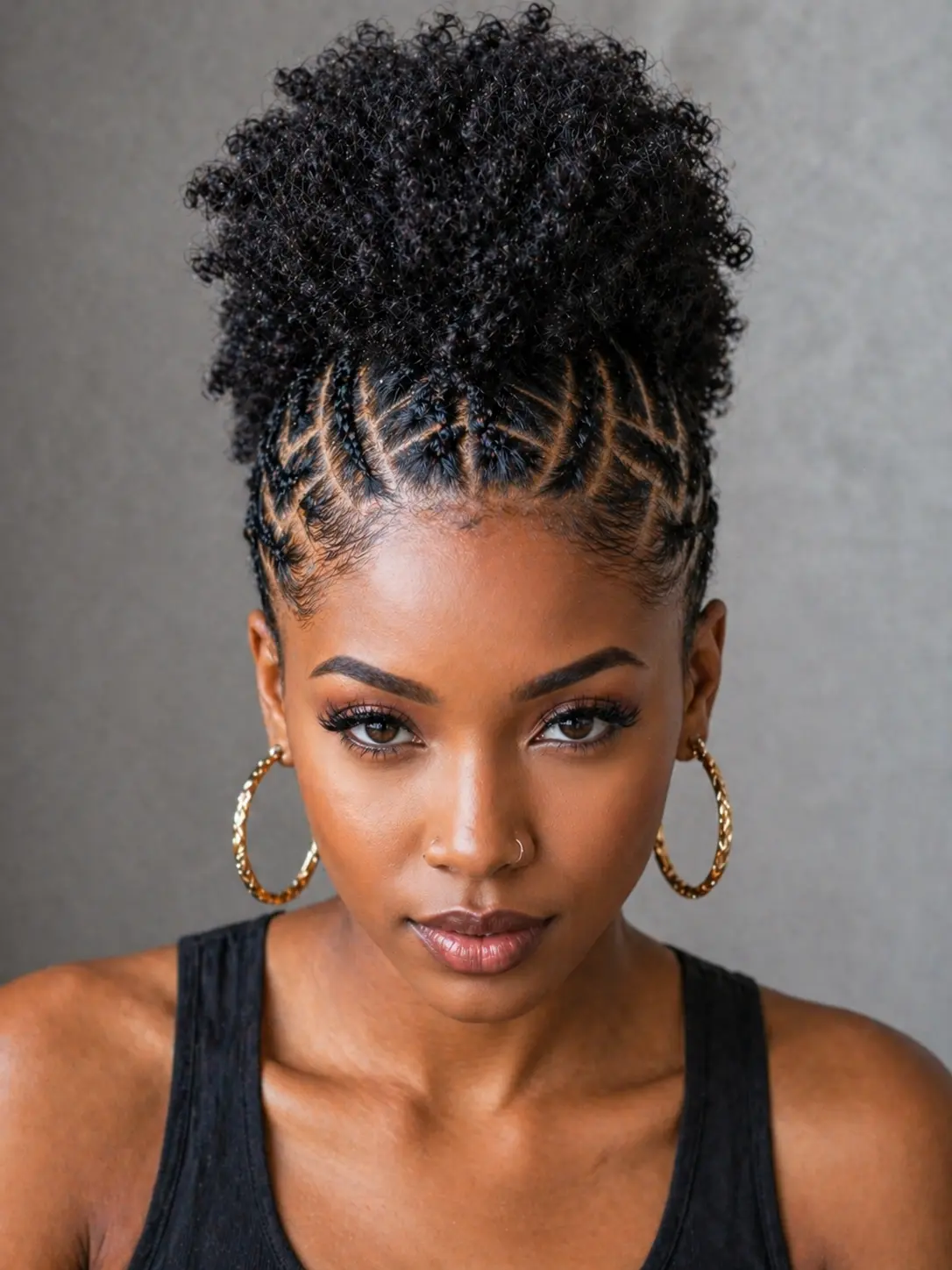
→ Full guide: Curly Mohawk Hairstyle
Braided Mohawk
The braided mohawk is the most widely worn female mohawk variation, particularly among Black women and women with natural hair. The structure: side sections braided flat to the scalp, central strip left free. The braid pattern on the sides, and what's done with the central strip, determines the specific look.
The range within this one style is enormous. Simple two-strand twists on the sides with a coily puff on top reads completely differently from intricate feed-in cornrows with geometric parts on the sides and a stretched blowout strip. Both are braided mohawks. Both use the same underlying architecture.
Side braid options:
- Cornrows — the classic. Rows braided front-to-back following the natural hairline. Clean, tight, long-lasting. The most common choice for both everyday and protective styling.
- Box braids — thicker sections braided individually. Can be done flat to the scalp or left to hang, depending on whether you want the sides completely flat.
- Flat twists — two-strand twists laid flat against the scalp. Slightly softer texture than cornrows, easier to DIY, still neat.
- Feed-in braids — cornrows that incorporate added hair for length and fullness. Common when the natural hair is short on the sides.
- Dutch braids — an inverted cornrow that sits raised above the scalp rather than flat against it, creating a 3D ridge effect.
Central strip options with braided sides:
- Natural puff — the strip is gathered loosely and secured at the crown, creating a rounded afro puff. The simplest and most common choice.
- Twist-out — the strip is twisted in sections, left to set overnight, then unraveled for a defined, separated texture.
- Wash-and-go — curl cream applied to the natural texture and left to dry, showing the curl or coil pattern.
- Straight and sleek — the strip is flat-ironed or blowout-stretched for a length contrast against the textured braided sides.
- Crochet addition — crochet hair is added to the central strip for length, volume, or a different texture than the natural hair.
- Updo variations — the strip hair is gathered into a bun, twisted upward, or pinned into a structured shape.
How long it lasts: With natural hair on the sides, the braids last 2 to 4 weeks before the scalp needs to be redone. With extensions, up to 6 weeks. The central strip is restyled daily or every few days.
Maintenance between refreshes: Lightly mist the braids with water and a leave-in conditioner spray every 2 to 3 days. Apply a light oil (jojoba, argan, or castor) to the scalp to prevent dryness and flaking. At night, cover with a satin bonnet to prevent frizz and extend braid life.
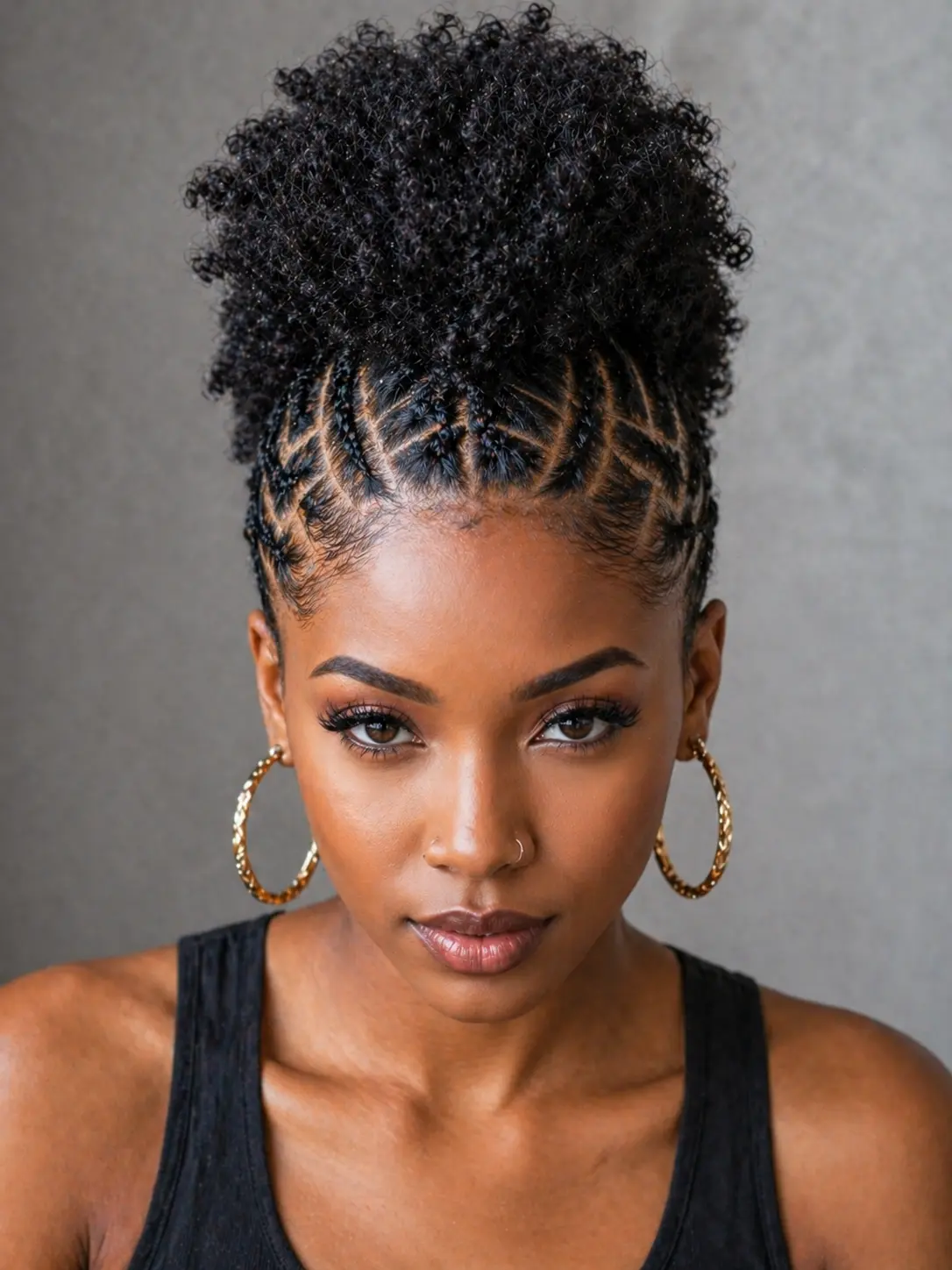
→ Full guide: Braided Mohawk Hairstyles
Faux Mohawk (No Cutting Required)
The faux mohawk creates the silhouette without scissors. All the hair stays at its original length — the side sections are simply styled upward or pinned back to simulate shorter sides, while the remaining center section forms the strip.
This is the most accessible version for women who are curious about the look but not ready to commit. It's also the go-to for formal occasions, costumes, editorial shoots, or anyone whose workplace wouldn't accommodate a permanent version on a Tuesday.
Method 1 — The Pin-Up Technique (most common)
- Part hair from the center of the forehead straight back to the nape, creating a central strip about 2 to 3 inches wide.
- Gather the right side section. Fold it upward toward the crown, creating a roll or a gathered cluster.
- Secure with bobby pins as close to the central parting as possible. The goal is to make the side hair disappear from view.
- Repeat on the left side.
- Style the central strip — waves, curls, a braid, or straight.
- Finish with hairspray to hold the pinned sections.
Method 2 — Elastic Row Method (works on long, thick hair)
- Create the center part front-to-back to define the strip.
- Starting at the forehead, gather a 1-inch wide section from the right side and secure it with a small clear elastic up toward the crown.
- Move back an inch and repeat. Continue until you've created a row of gathered sections along the right side.
- Fold each ponytail upward and pin it. Repeat on the left.
- The result is a more sculptural, organized version of the faux mohawk.
Method 3 — Braid-and-Pin (the most structured version)
- Define the central strip with front-to-back parting.
- Loosely braid each side section.
- Cross each braid up over itself and pin it flat at the top of the head, hidden behind the central strip.
- Creates a clean, defined line that stays put better than loose pinning.
How long it holds: 6 to 12 hours with proper pinning and hairspray. The looser methods need refreshing mid-day if you're active. The braid-and-pin version holds the longest.
Faux mohawk vs. braided mohawk: A faux mohawk keeps all the hair at its original length and is completely undone when the pins come out. A braided mohawk actually braids the side hair flat to the scalp, which is more permanent within the style (lasts weeks) but still doesn't involve cutting.

→ Full guide: Faux Mohawk for Women
Pixie Mohawk
The pixie mohawk is a short, cropped cut that expresses the mohawk structure in miniature. The central strip runs from the forehead to the nape but is kept close — maybe 1 to 1.5 inches — with the sides faded or tapered and the overall length compact. The result combines the pixie cut's clean, confident silhouette with the directional energy of the mohawk.
This is the most barbershop-forward female mohawk style. It requires actual cutting by someone who knows how to fade and shape. And it reads differently from a distance than the braided or curly versions: more precise, more architectural.
Pixie mohawk vs. short mohawk: A short mohawk has a longer strip than a pixie — usually 2 to 3 inches — that can be styled upward. A pixie mohawk's strip is very short (under 1.5 inches), barely raised, and the overall head shape is the thing that communicates the style rather than any dramatic spike.
Who it works best for: Women with fine to medium hair who want a bold, low-maintenance style. Women who've worn short hair before and are comfortable with how it grows out. Women with oval or heart face shapes who carry short cuts well.
What to tell your stylist: "Pixie mohawk — fade the sides down to a 1 guard or lower, keep the top strip at about an inch to an inch and a half. I want the center strip clearly defined but I'm not trying to spike it. Leave the front slightly longer."
Growing it out: The pixie mohawk grows into a regular pixie, then into a short textured cut, then into a bob with some patience. The grow-out is gradual and manageable — it doesn't have the awkward "in-between" phase of a longer mohawk growing out.

→ Full guide: Pixie Mohawk Cut
Natural Hair Mohawk (4c, 4b, Afro Textures)
The natural hair mohawk is specifically about celebrating coily, kinky, and afro-texture hair in a structure that amplifies what those textures do best: volume, shape, and presence.
Women with 4a, 4b, and 4c hair who search for "mohawk for natural hair" are usually looking for one of two things: a style that shows off their texture without fighting it, or a protective option that manages the hair while looking intentional. The natural hair mohawk delivers both.
The most popular natural hair mohawk styles:
Puff Mohawk
The sides are braided or tapered flat; the top section is gathered and secured loosely at the crown into a rounded afro puff. The puff's size depends on the length and density of the natural hair. On 4c hair with strong shrinkage, even a few inches of length can produce a full, dramatic puff.
Twist-Out Mohawk
The central strip is divided into sections and two-strand twisted while damp or freshly conditioned. The twists are left to dry completely — overnight is ideal. When unraveled the next day, the defined, separated coils create a textured, dimensional strip.
Wash-and-Go Mohawk
Product is applied to the damp natural strip, the curl or coil pattern is encouraged to form, and the hair is diffused or air-dried. No manipulation beyond the initial application.
Stretched Mohawk
The strip is stretched using a blowout on low heat or banding (wrapping sections with elastic bands while damp) to elongate the coils. This adds length and changes the silhouette from compact and rounded to longer and more dramatic.
Bantu Knot Mohawk
The central strip is sectioned and twisted into tight Bantu knots — small coiled buns pinned close to the scalp. Worn as-is, they create a sculptural, deliberate look. Left overnight and unraveled, they produce a coily, defined texture.
Key products for natural hair mohawks: Mielle Organics Rosemary Mint Strengthening Leave-In, Camille Rose Naturals Curl Maker Jelly, As I Am Jamaican Black Castor Oil Leave-In Conditioner, Aunt Jackie's Don't Shrink Flaxseed Elongating Curling Gel.
→ Full guide: Mohawk for Natural Hair
Black Women's Mohawk Hairstyles
Black women's mohawk styles deserve specific focus because the hair textures, protective styling needs, and aesthetic traditions involved are distinct enough that generic mohawk advice often misses the mark.
The most searched variations in this segment: black female mohawk (1,600/month), mohawk haircut black female (1,600/month), mohawk haircuts for black females (1,600/month), round face black female mohawk hairstyles (720/month), black female mohawk hairstyles with weave (170/month).
What makes these styles specific:
Most Black women's mohawk styles work with natural texture rather than against it. The coil and kink patterns that other styling guides treat as a problem to manage are the actual asset in these styles. The mohawk structure amplifies them.
Protective styling is a genuine priority. Cornrow sides protect the hair at the edges and temples — zones where Black women are most susceptible to traction alopecia. Keeping those areas braided flat for weeks at a time allows the hairline to rest and recover.
Extensions are commonly used not to change the look but to add length or volume to the central strip. Crochet hair, weave strips, or loose extension hair can supplement the natural strip for a more dramatic effect without chemical processing.
Styles specific to Black women's mohawks:
Mohawk With Weave in the Middle
The sides are braided flat (cornrows or box braids) and a weave or leave-out is sewn or attached to the central track for a different texture or added length. Popular for women who want a straight or wavy strip against natural braided sides.
27-Piece Mohawk
A specific quick-weave technique where the weave is applied in a way that creates a mohawk shape. The "27-piece" refers to the traditional piece count in a specific weave method, though today it's used more loosely to describe any weave-based mohawk.
Crochet Mohawk
Crochet hair is looped through cornrows on the central strip to add volume, length, or a specific curl pattern. The sides are cornrowed flat, and the crochet hair creates the visual density of the top. This is extremely popular because it can produce a full, dramatic look in a single salon session.
Mohawk Updo for Formal Events
The natural or relaxed strip is braided, twisted, or wrapped upward into a structured shape — a French roll, a twisted bun, a gathered updo — while the sides are smoothed or braided flat. Creates a mohawk silhouette with formal elegance.
Short Natural Mohawk for Black Females
Women with a TWA (teeny weeny afro) or very short natural hair can still achieve a mohawk effect by simply fading or shaping the sides much shorter than the center, even when the overall length is very short. The structure of the coil texture creates visible contrast even at small lengths.
What to tell your stylist:
- For a braided mohawk: "I want cornrow sides, flat to the scalp. Leave the center free. [Choose: puff, twist-out, or crochet addition.] Keep the cornrows no tighter than comfortable — I want to protect my edges."
- For a weave mohawk: "Cornrow base on the sides. Add a weave strip on the top — [straight / wavy / curly] texture. Leave a little leave-out at the hairline if you can."
- For a crochet mohawk: "Cornrow the full head to create a base. Crochet [hair type] into the center strip only. I want [full and voluminous / defined curls / long and straight] on top."
Edge care note: Always remind your stylist that edge tension is non-negotiable. The mohawk's visual drama comes from the top, not the edges — there is zero reason to pull the braids tightly at the hairline. If a stylist resists this, that's your cue to leave.
Short Mohawk for Women
Short sides, short central strip — the whole cut is compact and clean. The strip typically sits at 1.5 to 2.5 inches; the sides are faded or tapered. This is the version of the female mohawk that requires the least daily styling effort while still making a deliberate visual statement.
Why women choose the short version:
- Low styling time — 2 to 5 minutes with a small amount of product
- Clean, professional enough for most workplaces
- Hot-weather practical — much cooler than longer styles
- Works especially well with strong facial features that don't need length to frame them
Styling options:
- Flat and textured — matte product, fingers through the strip, no blow-drying. Natural texture shows.
- Slightly raised — a touch of medium-hold pomade and a quick blow-dry lifts the strip without making it aggressive.
- Slicked back — gel or edge control product combed straight back through the strip for a clean, sculptural look.
- Forward — product worked forward so the strip falls slightly over the forehead. Creates a softer, more casual effect.
For Black women with short natural hair: Even a very short 4c afro can be shaped into a short mohawk by fading or shaping the sides shorter. The coil pattern provides structure at minimal length.

Long Mohawk for Women
Long hair and a mohawk structure are not contradictory — but they do require making a decision about the sides. Either the sides get cut or faded (a genuine commitment), or they get braided or pinned back (reversible, no cutting).
With faded or cut sides:
The central strip runs shoulder-length or longer. The sides are faded, creating a dramatic contrast between the long flowing strip and the short sides. This is the highest-impact version — there's a lot of hair, but all of it is organized deliberately.
Styling options for the long strip: waves or curls for a romantic, dimensional look; sleek and straight for an editorial, high-fashion feel; braided for texture and movement. The strip can be worn loose or gathered into a partial updo.
With braided sides:
The sides are cornrowed or box-braided flat, and the long central section is left free. This creates a dramatic long mohawk without any permanent cutting. The length of the central section, combined with the flat braided sides, creates a strong visual ratio.
Best for: Women with enough natural hair at the crown to maintain a long central strip — medium-thick to thick hair works best. Fine hair tends to look thin at the edges of the strip when it's long.
Grow-out if you cut the sides: A mid fade grows out gradually and can be reshaped into a conventional longer haircut over 4 to 6 months with regular trims.

→ Full guide: Long Mohawk for Women
Bob Mohawk
The bob mohawk applies mohawk structure to bob-length hair. The sides are faded or shaved, and the central strip is cut at jaw length or chin length — the length that defines the bob. The strip can be straight, wavy, or curly.
This is a fashion-forward combination that doesn't appear as often as longer or shorter versions but creates a very specific kind of impact. The bob length gives the strip enough movement to look soft and styled, while the faded sides add the structure and drama that a conventional bob lacks.
Best for: Women who love the bob but want something more architectural. Women who want a cut that looks editorial without going very short or very long.
Styling: The bob strip can be heat-styled (waves, flips, curls) or worn in its natural texture. Keep the sides freshly faded for the sharpest contrast.

Afro Mohawk
The afro mohawk concentrates the volume and shape of a full afro into the central strip. The sides are faded or shaved, and the top — the round, full natural shape of the afro — is left completely intact over that central band.
The effect is spectacular on hair with high density and strong shrinkage, because the natural rounded shape of the afro creates a dramatic silhouette against the faded sides.
Rihanna's 2012 Met Gala look is the most-referenced example. Her version was more of a styled puff than a traditional afro shape, but the principle — maximum volume in the center, bare sides — is the same.
Who it works for: Women with dense natural hair, particularly 4b and 4c textures where shrinkage creates significant volume. Also works on big, full 3c and 4a hair.
Sides: Faded (for a clean, modern version) or completely shaved (for the most dramatic version). The choice depends on how stark you want the contrast.

Tapered Mohawk for Women
The tapered version uses scissors and clippers to shorten the sides gradually — shorter at the neckline and temples, longer moving up — without fading to skin. No sharp fade line, no bare scalp. Just a clean perimeter with a clearly longer central section.
This is the most workplace-appropriate variation. It reads as "interesting and deliberate" rather than "aggressive." It grows out the most gracefully of any version. And it works well on women who want the structural shape without the high-maintenance schedule of a skin fade.
What to tell your stylist: "Tapered mohawk — taper the sides with scissors, keep them at about a 2 or 3 but shorter around the neckline and temples. Leave the top section at [X inches]. I want a clean shape but not a full fade."
Choosing the Right Style: Decision Guide
| Your situation | Best style |
|---|---|
| 4c natural hair, want protective styling | Braided mohawk — cornrow sides, natural puff or twist-out on top |
| Curly hair (3a–3c), want to show off texture | Curly mohawk — faded sides or flat-twisted sides, curl cream on top |
| Long hair, don't want to cut anything | Faux mohawk — pin-up, elastic row, or braid-and-pin technique |
| Long hair, open to cutting the sides | Long mohawk — high fade, strip left at shoulder length or longer |
| Short hair, want minimal daily effort | Short pixie mohawk or buzz cut mohawk variation |
| Want dramatic volume, 4b/4c hair | Afro mohawk — skin fade, full natural afro on top |
| Professional setting, needs to be versatile | Tapered mohawk or braided mohawk with neat puff |
| Want formal/event styling | Mohawk updo — braided sides, strip twisted or rolled upward |
| Don't want permanent change | Faux mohawk — completely reversible |
| Want protective styling with extensions | Crochet mohawk or 27-piece weave mohawk |
| Fine hair, want the pixie version | Pixie mohawk — fade to 1 guard, 1-inch strip |
| Medium-length hair, want a fashion statement | Bob mohawk — jaw-length strip, skin fade or shaved sides |
Female Mohawk by Face Shape
The mohawk adds vertical height to the top of the head, which visually elongates the face. This interaction with face shape is important.
Oval: The most forgiving shape — every variation works well. Oval faces carry both dramatic and subtle versions without proportion issues.
Round: The mohawk is actively flattering. The vertical strip elongates a face that trends circular. Choose a strip with some height to it — even 2 inches is enough to shift the visual proportion. A mid or high fade on the sides reduces apparent width.
Square: Works well with the right approach. A braided mohawk or tapered version softens the strong jaw rather than echoing it. Avoid hard undercut lines and very tall spikes that can make a square jawline look heavy.
Heart (wide forehead, narrow chin): Avoid starting a fade too high — it widens the forehead further. A mid fade starting at the temple level, not above it, is the right call. A braided version with softer framing around the face is flattering.
Long / Oblong: Keep the strip short and flat to avoid adding visual length to an already-long face. A short bob mohawk or pixie mohawk is ideal. The braided version with a compact puff also works — the puff adds width rather than height.
Diamond (wide cheekbones, narrower forehead and jaw): High fades work beautifully because the widest point of the face is in a zone that can carry the contrast. A medium-length strip with a high fade is a strong combination.
Communicating With Your Stylist
Different styles require different types of appointments and different expertise.
For a braided mohawk: Book with a natural hair braider or loctician, not a general stylist. Bring reference photos for both the braid pattern on the sides and the top style you want. Ask specifically about edge tension before they start.
For a faded version (pixie mohawk, short mohawk, tapered): Book with a barber or a stylist who does clipper work. Many hair salons don't do fades — confirm before booking. Bring a reference photo. Tell them whether you want the neckline squared or rounded.
For a faux mohawk: Any stylist who does updos can do this. Or do it yourself at home — it's genuinely DIY-friendly once you practice the pin-up technique a few times.
For a crochet mohawk: Book with a braider who specifically offers crochet services. Bring the crochet hair you want to use, or confirm they have the right texture in stock. Discuss the strip width and crochet hair length before they start.
For a weave-based mohawk (27-piece, weave in the middle): Book with a stylist who specializes in quick weave or sew-in techniques. Bring a reference photo for the texture and length of the top strip.
Universal advice: bring two photos
One for the side/braid pattern, one for the top style. Even a rough screenshot eliminates most misunderstandings. The more specific the photo, the closer to your actual vision the result will be.
Maintenance and Care by Style Type
| Style | Refresh Schedule | Night Care | What Breaks It Down Fastest |
|---|---|---|---|
| Braided mohawk (natural sides) | Braid refresh every 2–4 weeks; top restyled daily | Satin bonnet or scarf over the entire head | Dry braids, not moisturizing scalp |
| Braided mohawk (with extensions) | Every 4–6 weeks | Bonnet always; don't let the braids dry out | Sleeping without protection; excessive moisture on braids |
| Faux mohawk | Reset each wear | N/A — take it down at night | Weak bobby pins; not enough hairspray |
| Curly mohawk (natural sides braided) | Top restyled every 1–2 days; braid refresh every 2–3 weeks | Pineapple the top with satin scrunchie; bonnet over | Not refreshing moisture on the curls |
| Pixie mohawk (faded) | Fade touch-up every 2–3 weeks | Moisture-based leave-in if strip has texture | Skipping barber appointments |
| Afro mohawk (faded) | Fade every 2 weeks; afro moisturized daily | Bonnet every night without exception | Dryness — 4c hair needs daily moisture |
| Short natural mohawk | Fade every 2–3 weeks; top minimal maintenance | Light leave-in, bonnet | Neglecting scalp moisture |
| Long mohawk (faded sides) | Fade every 2–3 weeks; strip trimmed as needed | Satin pillowcase; protective braid if very long | Skipping deep conditioner on the long strip |
Explore More Women's Styles
- Curly Mohawk Hairstyle: Best Looks for Natural Curls
- Braided Mohawk Hairstyles: The Full Style Guide
- Pixie Mohawk Cut: Short & Edgy Styles
- Dreadlock Mohawk: Loc & Dread Styles for Women
- Faux Mohawk: Get the Look Without Cutting
- Natural Hair Mohawk: Protective Styles Guide
- Afro Mohawk: Volume-Forward Natural Styles
FAQ
Does a female mohawk require shaving the sides?
No. Most women's mohawk styles involve no shaving at all. Braided versions create contrast by cornrowing or box-braiding the sides flat against the scalp. Faux mohawks use pins and elastics to simulate the shape temporarily. Tapered versions use clippers to shorten the sides without going to skin. Shaving is an option for the most dramatic results, but it's one choice among many — not a requirement.
Can women with long hair get a mohawk?
Yes. Long mohawk styles keep the central strip at shoulder length or longer while the sides are either faded (if you're open to cutting), braided flat, or pinned back with the faux mohawk technique. The faux version requires zero cutting — pin the sides up and you have the silhouette with all your length preserved. Braided versions with long cornrow sides and a free central section are among the most striking options for women with long natural hair.
What is the most popular female mohawk for Black women?
The braided mohawk — cornrow or box-braid sides with the central strip in natural texture — is the most widely worn. It functions simultaneously as protective styling, which gives it practical value beyond just aesthetics. The curly natural mohawk, the crochet mohawk, and the tapered natural fade are the next most popular in this demographic.
How long does a braided mohawk last?
Using your own natural hair on the sides, the braids last 2 to 4 weeks before needing a refresh. With extensions — crochet, box braids, or feed-in cornrows — the style can last 4 to 6 weeks. To maximize the life of the style: sleep with a satin bonnet every night, mist the braids with leave-in spray every 2 to 3 days, apply a light oil to the scalp weekly, and keep the central strip moisturized separately.
Is a female mohawk appropriate for professional settings?
Yes, with the right variation. A braided mohawk with a neat natural puff, a tapered mohawk, a faux mohawk, or a short pixie mohawk all read as polished and intentional in most professional environments. What creates issues in conservative settings is a skin-faded version with a tall spiked strip — but that's one specific variation in a very wide category. The vast majority of female mohawk styles are workplace-appropriate.
What face shape suits a female mohawk?
Oval, heart, and diamond face shapes carry the mohawk naturally. Round faces benefit from the vertical elongation the strip provides — go for a slightly taller strip and a mid or high fade on the sides to reduce apparent width. Square faces look best with a softer approach: a braided mohawk or tapered version rather than a hard skin fade with a dramatic spike. Long or narrow faces should keep the strip short and flat to avoid adding visual length.